
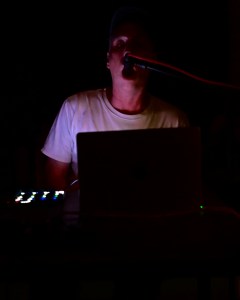
Photo by Vins Pedata. Courtesy the artist
Sven Fritz is an artist from Germany, who has various ongoing projects that explore performance, experimental music, and sound art. We had the chance to converse over email about his latest work, Der Saal tobt, realized under the Ervin Omsk moniker, published by Orange Milk. The interview was edited collaboratively with the artist.
David Murrieta Flores (ACL): Hi Sven, could you please talk a bit about the Ervin Omsk project for readers who are unfamiliar with it?
Sven Fritz (EO): Hi David, sure. Ervin Omsk is a pseudonym I’ve been using to release experimental electronic music since 2020. The name doesn’t actually have any special meaning; it’s simply an anagram of my two first names.
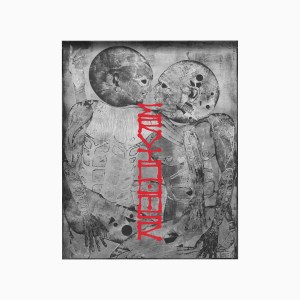
The project began in 2018 with a few musical collages that were strongly connected to the idea of exploring an abstract painting or sculpture in a particular room—in other words, a very spatial approach, in which I combined diverse sounds from a modular system, field recordings, voice, and so on. Fortunately, Orange Milk was willing to release these tracks on tape in 2020, with artwork by Keith Rankin. In 2023, a second album, titled Schmalster Point, was released on vinyl, with artwork by Brenna Murphy. Now the third album, Der Saal tobt, is being released on tape and CD, with artwork by Lukas Schmenger.
Ervin Omsk is currently one of several projects I’m working on. However, it’s the only solo project, and therefore also the most intense one. All my other projects are collaborative—for example, most recently with the French musician Amédée de Murcia. Together, we released an album in March on the Italian label Søvn. There’s also the Hui project, which I’m doing together with Johannes Schebler (Baldruin). An album has just been released on Jollies, and another one was released on Nonlocal Research last year. I’m also part of the artist collective Trickster, where I collaborate with with Stephan Engelke and sometimes other artists to realize scenarios in the sense of a Gesamtkunstwerk. My role here often involves musical performances lasting several hours and spread out over multiple days.
All of my projects fall within the realm of experimental electronic music, and Ervin Omsk really benefits from the many experiences I’ve had working with all these other musicians. This applies not only to production, but also to the concerts I play as Ervin Omsk. These performances, however, are more like interpretations or improvised versions of the tracks I release.
ACL: As the liner notes describe it, Der Saal tobt is mimicry of an orchestral body. Usually, we would understand such a body as mechanically efficient and well-coordinated, tuned and built through practice. However, the album understands it differently, and the result is slightly opposite: it’s a body that seems “unpracticed”. How do you understand the relationships between these bodies’ organs? How do you understand the differences between the modern, “well-oiled” orchestra and the album’s version of it?
EO: I recently went to a concert where a chamber ensemble performed a piece that really moved me. At the same time, I realized that I actually didn’t really know what was going on. I have no academic background in this field. For example, I lack knowledge of music history and theory, notation, instrumentology, the roles within an ensemble, and so on. So I can only form a vague idea of what is happening in this music. I sense its dissonance, complexity, and openness; at times, it almost feels improvised.
 At the same time, I associate orchestral music with something highbrow and inaccessible. And that would be, so to speak, a different perspective from the outside. I generally have a rather ambivalent relationship with high culture, because it often caters to unchanging expectations and cultivates a kind of institutional sophistication. And in this context, the terms “efficient” and “coordinated” become interesting: these are actually very performance-oriented categories, which I would spontaneously associate with economics and sport. What do they have to do with music? But yes, an orchestra also needs this high degree of functionality, because, for example, it follows an idea or an order in the form of a notation. The musicians ensure that everything runs smoothly because they have mastered their instruments.
To put it bluntly, we could argue that a modern, well-oiled orchestra must function—which sounds almost a bit cold and predictable. In music or art, however, I am not interested in categories like “well rehearsed,” “efficient,” and “coordinated” at first.
It is rather the state outside these functions that moves me. To me, the intuitive and the seemingly contradictory have always been special qualities. There is, for example, that brief moment when an orchestra or a small ensemble tunes up. It is an undefined jumble of sounds, a wonderful moment of uncertainty. I am fascinated by the orchestra pit and its sound. But I come from a different musical background, both technically and culturally. I only play guitar, I can sing, and I know some things about synths and computer music. So I can’t imitate the orchestra; I can only bring electronic instruments into play, which then, through practice, become their own form of an orchestral body. And the interactions between the organs aren’t without tension; they sometimes get in each other’s way, and they don’t always speak the same language. And that’s what makes their relationships so special to me. There’s no oil here—more like sand in the gears and friction, to stick with your analogy.
ACL: What is the process that you follow in order to craft a track? How do you understand the connections between tracks, once they are finished?
EO: I can hardly describe it, really. There is no linear or additive process: each track is the result of countless intuitive decisions, right down to the smallest moments. I’m obsessed with details. The computer of course offers infinite possibilities and an overwhelming freedom. But that also means I usually can’t remember how the individual tracks were made.
But I’ll try to describe it using the last track on the album as an example—which was actually the first track I produced: Right at the beginning, I made some very simple and short recordings of an alto recorder that I had borrowed from a friend and musician.
After sampling and processing these recordings, the flute’s physical qualities were still there—the airiness, the directness, the softness, the hiss, and so on—but I could tune it freely and also control its overtones and noise, among other things. In fact, it suddenly seemed more like a symbol for an entire group of woodwind instruments or like an instrument that wanted to be several at once. And yet it still had something artificial about it.
This impression was reinforced by the way it was played. Arpeggiators, whose tempo and rate were modulated by LFOs; animated envelopes that made glissandos possible; and the layering of several abstract flutes at once, varying only in their playing and sound. Then combined and blended with noises and glitches that picked up on the flutes’ patterns and intonations, countered them, and made them seem alien. Then it got a bit crowded, maybe like rush hour at the main train station. So then it was a constant process of sorting, resampling, stretching, compressing, cutting, copying, pasting, deleting, and leaving pauses—until the track was finished. Something like that, very roughly.
And as I said, there’s no single process that applies equally to all tracks. Other tracks have undergone several transformations. They were actually finished; then I completely rearranged them in the context of the entire album, because they didn’t feel right within the album’s dynamic, and the sequence of the tracks that unfolds over just 27 minutes.
In addition, on this album I deliberately used certain sounds—such as the processed alto recorder— in several tracks, either obviously or just as a trace. And then, for me, all the pieces take place in the same space; they’re close and direct.
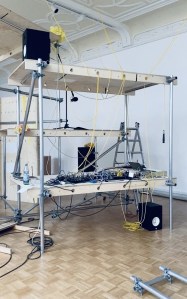
Photo of Trickster setup by Sven Fritz. Courtesy the artist.
ACL: What sort of gear do you use in this process? Thinking of gear less in terms of straightforward tools, and more socially in terms of extensions of your own thoughts and body, what does all this gear allow you to do? What does it inhibit you from doing?
EO: I always try not to own too much gear. Even in production, I use only a few very specific and experimental tools so as not to unnecessarily expand the range of possibilities: a small modular system, MIDI controllers, Ableton Live, with digital samplers, sound generators, M4L devices, a few effects, and then a few flutes and microphones.
I like the second part of your question. As a child, I played a home organ—two manuals, bass pedals. After that, I played electric guitar and sang for a long time, always in the context of bands. Vocals and guitar, in particular, are two very direct and physical instruments. It’s almost impossible to transfer that feeling to the world of synthesizers and computers, because playing them is less about gestures and more about fine motor skills involving the hands, fingers, eyes and ears: knobs, pads, trackpads, clicking, looking, listening and so on.
But when it comes to abstract thinking about music, synthesizers and computers offer another advantage. They expand the scope of what I can imagine musically and put me in a constant state of learning and wonder. It’s sometimes like a rush. Surely also because I don’t understand everything. But in any case, it changes my own perception of sound, because these machines basically function like auditory microscopes. You can dive incredibly deep with your ears and your thoughts.
ACL: Going back to the idea of orchestration, do you understand yourself as the orchestra’s director? Perhaps the orchestra itself, as an abstract embodiment? Perhaps the orchestra’s prompt-maker, to use contemporary code? In short – what is your own position within or without the orchestral body of the album?
EO: A prompt-maker relies on clear codes or language as commands, right? That wouldn’t be immediate enough. And unfortunately, I don’t know much about the work of a conductor. But if I may set that aside for a moment, it might be something between a conductor and the orchestra itself. Here’s how I picture it: there’s a room full of objects, no musicians. So I rush through the ranks and set these objects into motion, sound, gestures, and relationships with one another.
That would be very closely linked to experiences with live performances—both the role of the conductor and the abstract embodiment. Two examples:
There’s this collective project called Trickster, which I’ve already mentioned: very irregularly, we realize a series of evenings as an image—no hierarchy, no stage, no beginning, no end, and thus no mood-setting service. In one of the those projects, I arranged 6–8 different speakers, several mixers, an electric guitar, a spontaneous choir of friends, several synthesizers, a percussionist, and two friends playing the French horn and the soprano recorder, spread throughout a room of about 100 square meters. Here, my role was more like that of a conductor who, over the course of about five hours, activated and collaged all of this using clear impulses and several loopers. Charging and discharging the space, playfully and improvisationally.
Then recently I put together a live setup for some shows that had to fit into a backpack. A computer, two MIDI controllers, a small semi-modular synthesizer, and a microphone for vocals. Yet I prepared it in such a way that there were always five different instruments that I could play simultaneously. That was a bit demanding, but very direct, all on a small table—more as if I were many instruments, or, if you will, the orchestra itself. Turning knobs, playing pads, plugging in cables, tuning, singing, applying effects, controlling, not controlling.
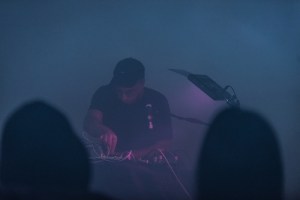
Photo by Matt Favero. Courtesy the artist.
ACL: I’d like to return now to the question of mimicry – it’s an aesthetically loaded term, but it’s possible to contrast it with the idea that there is something organic to the body we are listening to in the album. If we understand the album’s body as more of an automaton, what are its possibilities/capacities/abilities when thinking about traditional musical categories of representation like “expression”?
EO: Oh, that’s a really tough question, and I’m not sure I fully understand it. Mechanization could also be understood as a rigid and hierarchical process, but the automaton of the album feels alive to me. That would be more like a cyborg, right?
But sure, let’s stick with the image of the automaton. I don’t think of it as a concrete thing with a particular physical form, but rather as an abstract machine, as algorithms and processes. In order to see what abilities it has in terms of traditional musical categories, I have to listen to it. So I’ll pretend for a moment that I didn’t build the automaton. At first, it sounds to me like a machine that seems to define its own form, processes, and movements, acrobatic and unpredictable, like a shapeshifter. It leads an inscrutable life of its own. The mistakes it makes are constantly incorporated into its search for form. A complex and delicate act.
But only on the first, and perhaps the second, listening. Once you have become familiar with the complexity, the mechanisms, and the glitches, the form and nature of the automaton become clearer. Perhaps that is the moment when we can return to the “category of representation,” once we have understood the language of the automaton. Because “musical expression” may not be as organic, immediate, and human as we like to think. It is also part of a tradition and works through codes, conventions, expectations, and learned gestures—only seemingly self-evident.
The automaton, of course, is only indirectly part of this tradition. In this logic, perhaps the ability of the automaton does not lie in “expressing” something in the classical sense, but in using, shifting, exaggerating, or also refusing these codes of expression.
It maybe has the potential to transform many different sounds, instruments, gestures, figures, and experiments into a different but nevertheless familiar form of expression. And perhaps through its artificiality and distance it can make something audible that a human body would not do in this way. But the question really is very abstract. I hope I was able to give a somewhat meaningful answer here.
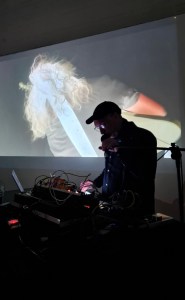
Photo by Tobias Ullrich. Courtesy the artist.
ACL: You did, thank you! Now, I’m interested in the meaning of the various track titles. There’s a playful overtone about things going wrong, failing in wholesome ways, or simply being the result of an essay in something (the “Memo Grisaille”, for instance, which alludes to the formative, practical painting made in shades of black or grey that emerged in the Renaissance). What links the process through which you made each track with the titles you chose for them?
EO: Collecting titles or sentences is an independent process that I and other friends have been practicing since art school. I’m interested in titles because they add an associative layer to the individual track or the entire album. The album artwork by Lukas Schmenger does that too, by the way. Like the artwork, the titles are an important part of the album, even though they only come into the process at a later stage.
I think the titles of the album relate in a certain way to its dynamics and moods. So I really associate the album title “Der Saal tobt” with an image of an agitated and unrestrained group of people. A feeling and sound somewhere between threat and excitement maybe.
At the same time, it’s important for me to break up some kind of sonic overload with an everyday and blunt remark like “Beim besten Willen,” which rather expresses a refusal or incomprehension. So I also like the laconic quality of titles. With “Memo Grisaille,” though, it wasn’t my intention to trivialize this art-historical term. I simply like the combination of the words in terms of their sound, and the piece has something fragile and searching about it, like a memory that only becomes sharp and distinct in certain moments.
So, with each title, there is an association that relates to the mood of the piece—with it or against it.
ACL: Your previous album already explored a sense of joy derived from electronic sound interactions. Considering the track title themes, I think the argument can be made that there’s a humorous undercurrent in Der Saal tobt – there’s a philosophical perspective that says, basically, that it’s funny when things act like persons, but also the other way around. As the album’s automaton furiously fumbles around, we could be inspired to laugh: have you ever thought of experimental electronic music as possibly funny? Would you see a role for humor within your work, in the past, now, and in the future?
EO: Experimental electronic music can be fun, sure. But so far, I haven’t gotten that feeling from this album. Then again, maybe I’m just missing something because I wasn’t sitting at the instruments or in front of the computer laughing while making it. Maybe it’s already fun when something unexpected happens. The staging of errors that make the automaton seem human, the unusual sounds, the friction in the gears, getting tangled up in the gestures—all of that could be interpreted as fun.
For me, these are necessities, because I fear a well-oiled machine—and thus the predictable. And perhaps also I can’t take things, or myself, too seriously. So there may, after all, be a certain humorous distance, and therefore an unconscious influence on the tracks. But as the author myself, I can’t hear it. And that means humor would not have a defined role right now. If anything, it just happens, as it does in encounters with other people. For me, humor is indispensable there.
In any case, I want to keep thinking about your question. There are quite a few inspiring examples in music, but also in visual art, that I would definitely describe as humorous. And maybe humor can get a more definite role in my work too.
ACL: Thank you very much for your time, Sven. Is there anything else you’d like to tell our readers before closing this interview?
EO: I’d like to thank you for these really challenging and intense questions. They went quite deep, and I found it very inspiring to think about them.
Now I’m curious to know what it’s like to listen to the album after reading this interview—how it affects the way we perceive and contextualize this music.
Especially since the album doesn’t necessarily need a strong conceptual framework, as it was created largely intuitively. Talking about it this way now almost feels like a kind of mental post-production, even though the music is already finished. And I consider it something special in itself to be able to release music like this, in the hope that there will be a few people out there who will actually listen to it and perhaps even find something in it.
Thanks again for this opportunity.

