
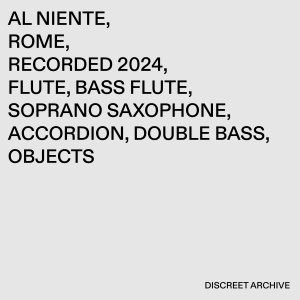
In musical notation, al niente means “to nothing”: a gradual fading until sound disappears. The title suits this debut by Beatrice Miniaci, Cosimo Fiaschi, Gabriele Pagliano and Luca Venitucci, a quartet whose music is shaped by subtraction. Three collective improvisations sit alongside compositions by Stefan Thut and Pagliano, with gestures pared down to small fluctuations of breath, timbre and silence.
The four musicians rarely behave as separate voices. In the accompanying interview, they describe coming to think of the ensemble as “one instrument instead of the sum of four different voices”, an approach that can be heard throughout the record. Flute, soprano saxophone, accordion and double bass converge into shifting composite timbres, occasionally separating long enough for an individual instrumental character to surface before being absorbed again.
Stefan Thut’s “Some, 1–4” uses an extremely limited vocabulary of sound and noise to produce a surprisingly fluid landscape. Small differences in duration and articulation create movement within a score that otherwise appears almost static. Pagliano’s “Umbra” is similarly economical, tracing the relationship between a gesture and its “shadow” through minute changes in resonance. Extended techniques belong to the music’s basic vocabulary: pitch gives way to breath, friction and resonance, while instrumental identities become increasingly uncertain.
Silence has an active role throughout. Venitucci describes it as a continuous field from which individual sounds acquire their presence, and the album makes that relationship unusually tangible. An attack or breath changes the space around it; a resonance continues to register as it approaches inaudibility. In the closing minutes of the final improvisation, the double bass briefly emerges on its own before the other instruments return and the music slowly thins away, approaching the niente of the title.
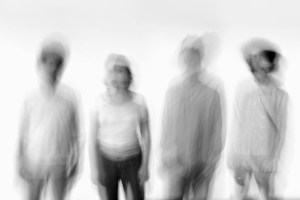
AL NIENTE – photo by Alessandro Carpentieri
To guide us towards silence, we reached out directly to Cosimo Fiaschi, Beatrice Miniaci, Gabriele Pagliano, and Luca Venitucci.
Listening to al niente, I often lost track of where one instrument ended and another began. The quartet continually reshapes itself into a single, evolving timbre before individual voices briefly re-emerge. Even in the collective improvisations, there’s very little sense of anyone stepping forward as a soloist. Is that something you consciously cultivate, or does it simply emerge from the way each of you listens and responds to the others?
The ensamble: Reducing the material down to its bare bones often implies unison, where one instrument is the continuation of the other. In a way, it felt natural to investigate the unison of four very different instruments, that do not share any (?) musical literature. Probably the idea of soloist ceased to be valid while working primarily with long tones and silences.
In both improvisations and repertoire, it seems way more interesting to think of the quartet as one instrument instead of the sum of four different voices. The music we made deals with few musical parameters in which details plays a crucial role: but a sharp attack or a little crescendo, for example, could also be the sings of a more prominent musical action which could be understand as some sort of soloist role.
In the last track of the album, at approximately six minutes the double-bass introduces the final with a brief solo. That action, for instance, could be understood as a soloist role, since it’s the only one with articulation, in the sense of density.
Stefan Thut describes “Some, 1–4” as a score in which the notated image seems to liquefy when it is brought into sound, only to return repeatedly to its original static form. Listening to the piece, I had the impression that the music was constantly oscillating between movement and stillness, almost as if the score itself were breathing. As performers, how did you approach that balance? Did the notation leave room for individual interpretation, or did it require a very precise collective discipline?
The ensamble: First of all, we really have to thank Stefan Thut for his availability and for agreeing to share his work with us. The piece consists of four combinations of the letters x and y, where x is sound and y is noise. We choose this piece for its simplicity within the relation sound / noise, as well as the interest in contingencies, since the individual sound and noise (one for every musician in both categories) are chosen a priori. The piece needs an individual discipline since each performer chooses only one of the four permutation (that is also chosen a priori): sound / sound; sound / noise; noise / sound; noise / noise. The oscillation between movement ad stillness you were referring to is generated through the different durations that each of us gave to each sound / noise. In this sense, it’s amazing how a very limited material (six different musical objects within four performers) can create such movements.
Both the flute and the soprano saxophone seem to occupy a particularly unstable position on the album. At various moments they cease to function as melodic instruments and instead become sources of breath, friction, multiphonics and noise, often blurring the distinction between pitched sound and pure timbre. How has your relationship with your instruments changed through working with al niente? Has this ensemble altered the way you think about tone production itself?
Beatrice Miniaci and Cosimo Fiaschi: The constellation of al niente (four acoustic instruments without resonances) is the perfect setting to let the subtle characteristics of the flute, bass flute and soprano saxophone emerge through the techniques you mentioned. The air quality is a particular trait d’union between the overall ensemble: the accordion is an aerophone too and the double-bass with the archetto is capable of producing many air sounds. Generally speaking, the overall dryness of the quartet in the discreet dynamics is the ideal setting to dig into the liminal zone between air and pitch for our instruments.
Pagliano, in your notes on “Umbra”, you describe the relationship between a sound and its “shadow”, referring to positive and negative sounds almost as if they were photographic images. Listening to the piece, I was struck by the fact that these shadows never feel electronic or artificial; they seem to emerge naturally from the instruments themselves. When composing “Umbra”, were you thinking primarily in terms of acoustics and resonance, or was the idea of the “shadow” also a way of exploring the relationship between action, memory and listening?
Gabriele Pagliano: Thank you for you deep listening. The core of this piece can be find in the gesture, or action, as a musical object. Every possible reflection about resonance or acoustic spectrum originates from there: the possibilities that come from the process of transformation, or permutation of a single or composed gesture. Even if the sonic texture has to take a central role in the performer thinking, the compositional approach revolves around this idea more than a spectralist approach in a narrow sense. In this perspective, the fact that we never feel these shadow parts “artificial” it’s a welcomed consequence; I think that the realm of the acoustic instruments it’s were the borders between sound and silence are the closest possible and in this sense the gesture is the device that naturally activates that relationship.
Venitucci, with more than three decades of experience in experimental music, you’ve worked in contexts ranging from free improvisation to contemporary composition. What fascinates me about al niente is its refusal to treat quietness as simply the absence of sound. Silence often feels active, almost as if it were another performer shaping the music. Has your understanding of silence changed over the years, and what does this ensemble allow you to explore that other improvising groups perhaps do not?
Luca Venitucci: My early approach to sound was shaped by rock and European improvised music of the 1960s and 1970s, and naturally tended towards rather assertive gestures. Later, through Ensemble Zeitkratzer, I came into contact with the Wandelweiser movement and Berlin’s Echtzeitmusik scene, which led me to develop a deeper awareness of silence, not as a mere absence of sound, but as a continuous field from which each sonic event emerges and takes on depth and presence. In al niente, this focus on silence brings the finest qualities of sound into the foreground, revealing the subtle transformations and inflections that arise from each musician’s intentions and from their interaction.
(Gianmarco Del Re)


Pingback: Recent Reviews from A Closer Listen – Avant Music News
Pingback: Recent Reviews at A Closer Listen – Avant Music News