
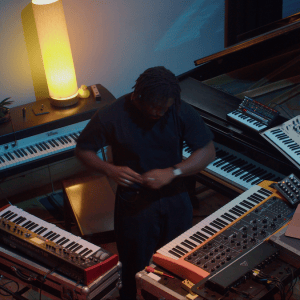
Tony Njoku‘s recent work has moved between open-ended instrumental composition and song. A WORLD OF BODIES ON FIRE continues this movement in a more intimate setting. Across four pieces, piano, synthesisers and space provide the foundations of the music.
The title track establishes the EP’s sound through layers of synthesiser harmonies that gather pace but stop short of a conventional climax. “Streams and Storms” turns towards private reflection, while “The Quiet Chaos of Playing It Safe” holds onto its tension without seeking a dramatic release. “Etude No. 1” strips the music down again, bringing the record to a sombre close.
As Njoku explains in the accompanying interview, his move away from language is connected to an interest in how music can communicate feelings before they have been organised into words. Grief, exhaustion and recovery remain unresolved, expressed through harmony, resonance, dynamics and space. Small harmonic changes assume greater significance within these sparse arrangements.
This is no suite in four movements, with constrasting character and same key signature. A WORLD OF BODIES ON FIRE is a protean EP that searches and digs inwards, taking unexpected turns without any desire to dazzle. There is no show-off moment, no virtuoso display demanding attention, nor any grand moment of portending grief; emotion remains understated and kept in check. The music is unafraid of intimacy, allowing sustained harmonies, shifts in density and silence to determine its course, leaving much of the experience behind these compositions unspoken.
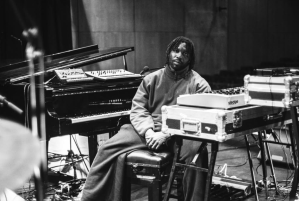 To help us put out the fire we reached out directly to Tony Njoku for an interview conducted via email.
All Our Knives Are Always Sharp was a large-scale collaborative statement concerned with spiritual preparedness, cultural resistance and collective survival, while the Bloom releases increasingly embraced instrumental composition, chamber arrangements and themes of grief, memory and renewal. A WORLD OF BODIES ON FIRE feels like a further step in that direction: intensely personal, largely wordless and driven by the need to work through difficult emotions rather than narrative.
Do you see this EP as the culmination of a journey that began with those recent releases, or did it emerge from a fundamentally different place?
I don’t think of it as a culmination so much as another point of arrival. Each project tends to emerge from whatever questions I’m living with at the time. All Our Knives… was very outward-facing. It was about community, about bringing different voices into conversation around ideas of resilience and collective memory. Bloom and the instrumental work that followed became quieter spaces where I could sit with loss, change and the slower work of transformation.
A WORLD OF BODIES ON FIRE came from an even more internal place. I wasn’t trying to tell a story or resolve anything. I was more interested in documenting a state of being and exorcising some pent-up feelings that were essentially causing me harm. The music became a way of staying present with difficult emotions rather than translating them into language. In that sense it feels connected to the recent releases, but I wasn’t consciously trying to complete a trilogy or close a chapter. It simply became the form those experiences needed.
One of the recurring threads across recent works—from The Loops (Grief) and Looking For Light to the standalone single “Malaise”—is an engagement with emotional turbulence that is neither entirely despairing nor entirely hopeful. The title track of A WORLD OF BODIES ON FIRE speaks of moving through fire rather than escaping it. Has your understanding of grief, burnout and recovery changed over the course of these releases, and do you think this EP arrives at a different emotional destination than those earlier works?
I think grief has become less about something to overcome and more about something you learn to live alongside. Earlier work probably carried a stronger desire to find resolution or to move towards the light. I don’t think I see it that way anymore. Recovery isn’t linear, and neither is burnout. There are moments of joy inside exhaustion and moments of uncertainty inside healing.
The image of moving through fire rather than escaping it felt important because some experiences can’t be bypassed. They change you. The music on this EP isn’t trying to extinguish the fire; it’s trying to understand what remains after you’ve passed through it. If there’s hope here, it’s a quieter kind. It’s found in endurance, attention and the possibility of continuing to create despite everything.
One of the striking aspects of All Our Knives Are Always Sharp was the way you brought together an extraordinary community of Black British voices—Tricky, GAIKA, Ghostpoet, Coby Sey, James Massiah, Space Afrika, Labi Junior and others—creating a record that felt simultaneously personal and collective. More broadly, your recent work has moved freely between songs, spoken-word collaborations, chamber-like compositions, ambient electronics and abstract instrumental forms. By contrast, A WORLD OF BODIES ON FIRE feels almost entirely self-contained, built around piano, synthesisers and extended instrumental pieces. After such a collaborative album, did the absence of other voices create a different kind of honesty or vulnerability?
Collaboration has always been fundamental to my practice because it allows ideas to exist beyond my own perspective. All Our Knives… couldn’t have existed without those voices. The conversations between people were the point of the record.
With this EP I found myself needing the opposite experience. I needed solitude, not because I wanted to withdraw from community, but because I needed to hear what was underneath all the noise. Working mostly alone meant there was nowhere to hide. Every hesitation, every silence, every decision belonged to me. That can feel vulnerable, but it can also be very freeing because you’re no longer trying to explain yourself through words or through other people’s interpretations. I also needed space to cry and I find that’s a hard thing for me to do in front of people, I let go of my masks the most in solitude.
So it became a conversation with the instruments themselves. The piano, synthesizers and space all became collaborators in a different sense.
You’ve described this EP as a collection of “raging exhalations, quiet revelations, subtle smirks of humility, laments and meditations.” Unlike many of your previous releases, there are no guest vocalists, no lyrics and no obvious narrative anchors.
Did working without words feel liberating or exposing? And at this stage in your career, do you feel instrumental music has become just as capable as song of carrying the political, spiritual and emotional concerns that have always been central to your work?
Working without words was both liberating and exposing. Lyrics can sometimes direct people towards a particular meaning, whereas instrumental music leaves much more room for the listener’s own experience. That openness was something I wanted to embrace.
I’ve become increasingly interested in what music communicates before language enters. Breath, texture, resonance, silence… these things carry meaning too. They can hold emotion in ways that words sometimes can’t.
I don’t really separate instrumental music from song anymore. They’re just different ways of asking the same questions. The political, spiritual and emotional concerns that have always interested me don’t disappear when language disappears. They become embodied differently. Sometimes a sustained note or a shift in harmony can express something that would become smaller if I tried to explain it.
(Gianmarco Del Re)

