
 Across its seventeen tracks, Wahj brings together electronics, industrial textures, processed strings, Arabic vocal traditions and fractured rhythms in combinations that keep changing shape. Individual elements remain recognisable without settling into familiar forms, while images of voice, disappearance, radiance and return recur throughout the album.
Wahj took shape over five years, and the events of that period inevitably entered the music. As Toni Geitani explains in the accompanying interview, the album was not initially conceived as a meditation on collapse. The idea emerged gradually as the circumstances surrounding its composition changed. Collapse here is not a single catastrophic moment. Ruin exists alongside what persists, with Geitani attentive to the lives and voices that political violence can obscure.
This runs through the lyrics as well as the music. Voices appear and disappear, sometimes sounding like invocations, sometimes carrying fragments of collective memory. On the brief “Sawtuka”, Geitani repeats, “Raise your voice higher and higher. Even if they bind you, even if they take you through death, the echo of your voice will remain forever.” The refrain turns persistence itself into an act of resistance. “2092” projects the idea into an imagined future in which “every fascist has fallen, and their glory belongs to nothingness,” before asking, “Does love remain when everything has vanished?” “Hal”, “Ruwaydan Ruwaydan” and the extended instrumental closer “Madda Mudadda” draw on ritual, repetition and moments of ecstatic release, with their meanings left open.
The title, Wahj, points towards radiance, although Geitani gives the word no easy redemptive meaning. Light appears amid destruction, sometimes faintly, and does not cancel what surrounds it. In “Tuyoor”, the image is carried by birds: “The birds flying above you do not belong to the ruler who oppressed you. They watch the sky, not the earth beneath you.” The image opens a space outside the authority of the ruler, even while that authority continues to shape life below. Throughout Wahj, Geitani keeps returning to such spaces: voices that outlast attempts to silence them, traces of love after disappearance, and forms of life that continue amid devastation.
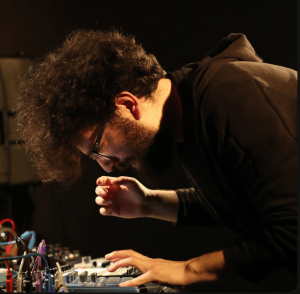 To discuss the making of Wahj, we approched Toni Geitani directly.
Wahj is described as an album about collapse, but one that refuses to remain trapped within its concept. Across the record, images of ruin, mourning, exile, and disappearance are constantly accompanied by gestures toward radiance, return, and endurance. How did you approach balancing these opposing forces while writing the album?
I didn’t start working on the album with any intention of a “theme”, in this case collapse. I also wasn’t trying to narrow down the album to one thematic focus. It was an intuitive process that mostly guided the work. But it is true that as the project developed over five years, a lot of horrific events unfolded; consecutively and sometimes simultaneously. This naturally affected the relation to my work in a way that pushed me into ending up with these tracks, which I could eventually describe as being about collapse.
By saying that the album refuses to be reduced to collapse, I’m intentionally pushing back against the idea that collapse is only a sudden, singular catastrophe.
I was born in the 1990s in post-civil-war Lebanon, so from early on I was surrounded by war stories told by family and friends. After continuous exposure to these stories throughout my life, I came to understand that they were not stories of the past only, but of a collapse that kept resurfacing in different forms. At the same time, however, I was also exposed to another image of collapse that dominated global media and felt especially present in my teens in the 2000s. It was that of an image imported from the West, romanticized, and flattened into spectacle. It also ignores how, for some populations, collapse is already ongoing rather than a problem of the future or an isolated incident that can be inherited and prolonged. That difference matters to me because, for many of us, imperialism, colonialism, and capitalism are not warnings of an apocalypse to come, but they morph to become ongoing and almost fixed conditions.
So when I was writing Wahj, I didn’t feel that I was trying to balance opposing forces simply because I do not see them as opposing, but inevitably coexisting. Instead, I was trying to remain faithful to everything catastrophe-centered narratives tend to erase: memory, resistance, regeneration, and the human capacity to continue. They are what must be reclaimed from within it.
The lyrics repeatedly return to voices, echoes, and acts of calling out across distance. In “Sawtuka” (“Your Voice”), for example, the refrain insists that a voice survives even imprisonment or death, while tracks like “2092” and “Tuyoor” are structured around questions of who is listening and who remains absent. What role does the voice play in Wahj—as memory, resistance, testimony, or something else entirely?
For this album, I composed the music before writing the lyrics. I would often record a vocal melody, sometimes with words that made sense and sometimes not, simply to find a fitting flow and have it as a placeholder until the final vocal recording. But before I began writing and recording the lyrics, the genocide in Gaza began alongside the war on Lebanon in 2023, so I stopped working on the album because I felt uneasy about prioritizing it. At that point, nothing made sense anymore. But somehow, by the beginning of 2025, I found the motivation to finish the project, and thus the lyrics were written.
In my opinion, the voice can hold many roles at once, including the ones mentioned in the question. It is not intended to be a tool for meaning-making, but rather a presence moving through space, carrying the emotional and political conditions of that space with it. However, its position is immanent rather than observational. It does not stand outside the world to explain it. Instead, it emerges from within that world and continually reaches outward, while refusing to die.
The lyrics inevitably reflect the experience of witnessing a 24/7 livestreamed ongoing Palestinian genocide, and the rage, injustice, betrayal, pain, and constant aggression we have been dealing with for many years. However, I do not wish to limit the album’s interpretation to the events of the past three years. As I mentioned earlier, collapse is not a one-time event or a singular fall, but I insist that it emerges from an ongoing oppression imposed on us by the same death machine.
Musically, the album moves between processed classical instruments, layālī-inspired vocal passages, industrial textures, dark ambient atmospheres, and fractured electronic rhythms without ever fully settling into any one genre. Did you begin with a clear sonic vision for Wahj, or did this hybrid language emerge gradually during the five years of recording between 2021 and 2025?
I did begin with a fairly clear sonic vision for Wahj, in the sense that from the beginning I wanted it to explore different genres and subgenres while still remaining rooted in electronics. What emerged gradually was not that intention itself, but the specific language the album took on through time, collaboration, experimentation, and everything that happened across those years. After releasing my first album in 2018, I wanted to keep exploring and collaborating before putting out another record. Between 2018 and 2020, I performed many live shows in Lebanon, where improvisation became an important space for testing new ideas and compositions. Over time, this left me with more than a hundred sketches, from which I selected the ones that felt less attached to a single genre and more committed to a shared atmosphere and universe, even if that universe itself remains unstable and fluctuating.
When I began my studies at the Conservatorium van Amsterdam in 2021, that process expanded further. Being surrounded by many different kinds of musicians pushed me to explore classical instrumentation, processing, and different digital approaches in ways I had not tried beforehand. I recorded many phrases and ideas with musicians there, often without knowing exactly what their final form would be, because part of the process was discovering how their playing could be transformed and absorbed into the album’s sonic world. In that sense, the hybrid language of the record was both intended and gradually revealed.
As mentioned earlier, I returned to working on the album in the beginning of 2025, and that final period inevitably shaped the work in a profound way. So while the album’s sonic foundation was there from the beginning, its final form was shaped by a long process of experimentation, disruption, and response to the world it was being made within.
Several tracks evoke futures rather than simply documenting the present. The title “2092,” in particular, imagines a distant horizon where “every fascist has fallen and their glory belongs to nothingness,” while love and memory continue to endure. What attracted you to speculative or future-oriented thinking as a way of responding to contemporary political realities?
I would like to make a distinction between futurism as typically understood through a Eurocentric lens which is rooted in Euro-American frameworks and historically entangled with imperialism and fascism – and counterfuturism that emerged from the Global South which functions to complicate normalized notions of time and technology rather than projecting a single vision of the future. And this is precisely what I intend to convey in the practice of imagining futures in the album, which attempt to articulate a cultural politics of time and become a means of writing alternative histories that distance themselves from any established history already written. This could mean reclaiming the right to think beyond imperialist scripts through collective knowledge, agency, and world-making rather than celebrating rupture, domination, or heroic modernity.
In other words, I’m trying to open possibilities from within collapse, and thus, this framework differs from futurism as an approach for technocratic future-thinking.
For example in “2092”, I try to treat the future as a tool to ask whose futures have been denied or flattened, instead of assuming it operates in a single path of progress. The political visions I sing about are not predictions, but they gesture toward an intense need to imagine the aftermath of collapse in the hope that something promising might emerge from it. That being said, I don’t intend for my songs to be frontal or overly obvious in their interpretation, and I welcome listeners to bring different meanings to them.
You wrote a master’s thesis titled Sampling as a Political Medium, examining questions of power, appropriation, and cultural memory. Wahj incorporates repurposed regional sounds and references while constructing an entirely new sonic language. How has your thinking about sampling evolved since that research, and how do those ideas inform the album’s relationship to Arabic musical traditions and collective memory?
My thinking on sampling has certainly evolved, although I do not see it as a linear progression that concluded with my thesis. The research was conducted alongside the creation of the album and I continue to work with samples, therefore I am always interacting with this topic.
Throughout Wahj, I work with both political and non-political samples that either have a political or non-political intention. For example, samples from my personal life, my urban surroundings, and of traditional instruments, the choice is more nuanced because it’s integrated and processed within the soundscape and ambient textures. However, for samples that are more frontal and forward, like the sampling of Amal Dunqul’s poem, “Spartacus’ Last Words” in “Madda Mudadda” the intention is more clearly deliberate and explicit.
These choices are bound to spill into collective memory, as I am borrowing sounds from my surroundings and heritage. Take the sample of Lebanese singers Sabah, Wadih El Safi, and Walid Gholmieh in “Wasla”; I was drawn to their voices for reasons I can’t quite articulate. But the moment I tried fitting the sample into the track, it felt seamless. My sampling choices are meant to re-activate archive sound, and insert these historical moments into the present to let them speak again through a different context. All voice samples from the album come from televised interviews, and I chose them not only for their raw, untampered sound, but also because they carry something of the world they were recorded in. To sample them is to pull them back into light and reactivate voices forced to be erased for new audiences, while also making visible the power structures that determine whose memory is preserved and who is erased from the record.
Ultimately, these sampling choices are always, in some way, in conversation with the cultural memory I carry, bringing the historical in contact with the contemporary.
(Gianmarco Del Re)


Pingback: Recent Reviews at A Closer Listen – Avant Music News