
Arshan Najafi‘s Zenosyne takes its title from John Koenig’s neologism describing the unsettling sensation that time seems to accelerate as we grow older. The album focuses on the paradox behind that sensation. As Najafi explains in the accompanying interview, the music emerged from a period in which he felt psychologically frozen while time rushed relentlessly onwards. This tension between stillness and acceleration defines the album’s two long-form electroacoustic compositions.
Built from live improvisations using a piezo microphone attached to an external hard drive alongside the sonification of raw digital data, Zenosyne makes surprisingly little ceremony of its unusual sound sources. The hard drive becomes another resonant object, its vibrations feeding a semi-generative system that Najafi actively steers. Algorithmic processes introduce an element of instability, but his intervention remains central to the shape of the music.
The opening “Binary Bloom” begins with almost imperceptible movement. Sustained electronic tones slowly develop interference patterns and harmonic beating, gathering momentum from within. Energy and apparent speed continue to increase without reaching a conventional climax, and the accumulated tension eventually dissipates. “Static Rotation” expands this language through a more active dialogue between pure tone and electronic noise. Its materials circulate around an unstable centre, creating perpetual motion with little sense of arrival.
Najafi places considerable trust in microscopic change. Much of the musical activity remains concentrated in the lower and middle registers. Rhythm and dramatic contrast play relatively small roles, while subtle redistributions of spectral energy, minute shifts in timbre and constantly evolving resonances determine the form. Musical time is stretched sufficiently for these small changes to acquire unusual weight, sharpening our awareness of its passing.
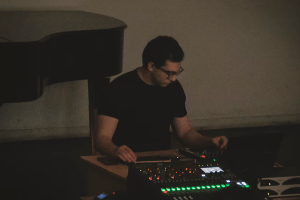
To get an idea of Arshan Najafi’s live process, here is a recording of one of his no-input mixer and computer sets, followed by an interview about the making of Zenosyne.
 Zenosyne takes its title from John Koenig’s neologism and yet the album doesn’t seem to represent memory nostalgically. Instead, both “Binary Bloom” and “Static Rotation” seem to suspend chronological time altogether, creating spaces in which microscopic changes become more significant than linear progression.
How did the idea of Zenosyne shape your compositional thinking? Were you interested in evoking the psychological sensation of accelerated time, or in constructing an alternative temporal experience in which conventional notions of duration begin to dissolve?
I chose the title Zenosyne because it perfectly captured my state of mind during the composition process and still does. I was experiencing this overwhelming feeling of staying completely still – almost a sense of uselessness or incapability – while watching every day pass by in a flash of light. The music reflects that paradox. The suspension of linear time you noticed in these pieces wasn’t necessarily a conceptual design to challenge musical duration, but rather a direct mirror of that personal, psychological standstill. It is the feeling of being frozen in place while time accelerates around you.
Your previous releases, from Imaginary Crisis to Live at Daa Theater House, have consistently explored live electronics, improvisation and the instability of sound in performance. Zenosyne continues that trajectory, drawing on live recordings made with a piezo microphone placed on an external hard drive alongside the sonification of raw digital data.
What attracted you to treating a storage device not simply as a technological object but as a resonant instrument? Did working with the physical vibrations of digital memory alter the way you think about the relationship between information, sound and materiality?
I have to admit, the reason is a bit less poetic than treating the drive as a metaphor for digital memory! I have a habit of attaching piezo mics to anything that I basically can. Frankly, I don’t see much point in recording traditional acoustic instruments anymore. That’s one of the main points of electronic music for me: it obliterates the need for conventional instruments. It gives us the freedom to choose the most mundane surface or object as a sound source and manipulate it into an entirely new form. The hard drive was just a fascinating object to harvest raw frequencies from, which the computer then allows me to further process.
Both pieces were improvised live in Max/MSP before being shaped during the mixing process in Ableton Live. Listening to the album, there is a constant negotiation between systems that appear algorithmic and gestures that feel spontaneous or instinctive.
How do you understand improvisation when working with generative processes? Do you see yourself directing the system, collaborating with it, or responding to behaviours that emerge unexpectedly during performance?
I definitely see myself as the director of the system. I design a semi-generative algorithmic environment that responds to incoming signals based on parameters I’ve dictated beforehand. I call it “semi-generative” because I intentionally build it to a point where it still requires my interaction to continue its work; it cannot sustain itself without being steered and not sound boring to me. I view live improvisation fundamentally as a technique of composing on the fly. Because there are physical, unpredictable elements – like the random fluctuations of the hard disk spinning in “Static Rotation” – I have to remain hyper-aware and react to sudden gestures, not to mention I often cause those sudden gestures myself because I feel it’s needed at that particular moment. It’s a constant dialogue between the rules I set and the behavior the system throws back at me.
Your work moves fluidly between sound, image and text—you are not only a composer but also the author of Twenty Wrong Turns. Across these different media there seems to be a recurring interest in fragmentation, ambiguity and the ways meaning emerges from incomplete information.
Does Zenosyne belong to that same broader artistic inquiry? More generally, how do writing and sound composition inform one another in your practice, and are there ideas that can only be explored through one medium rather than the other?
To be completely honest, I haven’t consciously intertwined my music and my writing so far. I tend to treat them as separate practices that serve different purposes. However, the connection that I do see between these mediums is the word “composition” itself, as I fundamentally treat them the same way. That’s the whole point for me. While they usually exist on their own, I might occasionally bring them together – it really just depends on how I feel about a certain project.
(Gianmarco Del Re)


Pingback: Recent Reviews at A Closer Listen – Avant Music News