
 33 takes the traditional age of Christ at his death as the axis of a twelve-part electroacoustic cycle concerned with creation, incarnation, suffering, death and renewal. Yara Mekawei and Amir Rezk draw on biblical passages, Coptic Orthodox liturgy and Arabic recitation, but rarely allow the texts to remain intact: voices are repeated, stretched and submerged until scripture begins to function as rhythm and texture. Dense drones, fractured percussion, recitation and sudden clearings give the record a ceremonial character without turning it into devotional music. Its structure is particularly effective. “LOGOS” begins with John’s “In the beginning was the Word”; by “New Creation,” Revelation has replaced Genesis, with the first heaven and earth passing away and death itself disappearing. Between them, “Mysterion,” “33,” “Harrowing of Hades” and “Sackcloth Love” trace a passage through Eucharist, Crucifixion, descent and mourning.
Musically, 33 sits between electroacoustic composition, dark ambient, and industrial electronics with a hint of prog rock, although none of those descriptions quite accounts for its restless construction. Mekawei and Rezk work with low drones, distorted orchestral sonorities, spoken voices, granular processing and percussion that repeatedly breaks apart just as it appears to settle into a pattern. The music can be oppressively dense, then abruptly hollowed out to expose a voice or a thin electronic residue. Rather than using electronics as accompaniment to the religious texts, the pair subject voice and instrumental material to the same processes: syllables become pulses, recitation turns into noise, and acoustic sounds lose their identifiable origins. This constant movement between intelligibility and abstraction gives the album much of its tension.
What begins with a private anxiety surrounding the age of 33 expands into a work about mortality and transformation, with ancient texts treated not as historical artefacts but as material that can still be sounded, fractured and inhabited.
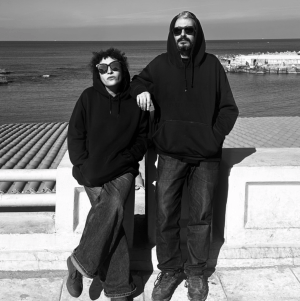 To help us further navigate the album, we reached out directly to Yara Mekawei and Amir Rezk.
33 seems to follow an unusually coherent spiritual trajectory: from the Logos and creation in “LOGOS” and “Genesis,” through embodiment, suffering and death, to resurrection and finally the New Jerusalem in “New Creation.” Yet the album never feels like a straightforward retelling of scripture; texts are fragmented, repeated, obscured and absorbed into the electronics.
Did you conceive the twelve tracks as a narrative or liturgical cycle from the outset, and how important was it that this progression could be felt without necessarily being understood literally?
From the very beginning, we did not set out to create a straightforward textual retelling or a literal recitation of scripture. For us, the sacred texts are not static history; they are a living, sonic score.
The progression across the twelve tracks was essential because we recognized that the trajectory of Christ’s life, from incarnation and embodiment, through suffering, descent, and ultimate renewal, is not merely a historical or theological timeline. It is a universal, spiritual archetype. It is a pattern that exists in the world and plays out in our own lives, in human endurance, migration, grief, and rebirth, whether we consciously recognize it or not.
By weaving Yara’s personal story, her family inheritance, her grandmother’s warning, her lived experience of displacement and transformation, into this grander framework, the album becomes a dual narrative. The fragmentation, repetition, and electronic processing of the texts reflect how personal memory and sacred history actually operate in human consciousness: rarely as a clean, linear text, but as lingering textures, echoes, and internal pictures. It was crucial that a listener could feel this emotional and spiritual weight instinctively without needing to decipher every word literally, because the underlying trajectory of endurance and transformation is something universally felt in the human spirit.
The number 33 begins from something intensely personal — a maternal warning about the thirty-third year of life — but the album gradually connects that age to Christ’s suffering, death and resurrection. In the title track especially, the language of Isaiah’s suffering servant and the Crucifixion seems to make personal vulnerability and sacred history overlap.
How did that private association with the age of 33 become the organising principle of the record, and did making the album change what that number meant to you?
The connection became obvious the moment we realized that 33 was not just a personal chronological marker, but the darkest point in Christ’s earthly life, the threshold of Gethsemane and the Cross, where He faced an unrepeatable cup of unknown suffering and abandonment. In our own human lives, those rock-bottom moments, where we carry an unbearable personal weight or face severe displacement, often become the precise pivots for profound transformation. The warning Yara inherited about the thirty-third year was essentially pointing toward this exact kind of personal Gethsemane: a room where you are tested to your limits, forcing a parallel between our lived vulnerability and what Christ endured.
Creating 33 completely changed what that number means to us. Through the process of writing and immersing ourselves in these detailed sonic patterns and raw emotions, 33 transformed from an ominous, looming warning into a symbol of profound solidarity. It fixed a truth in our minds: our suffering in this life is never meaningless, nor is it carried in isolation. The Divine chose to step into human history and share directly in our exact grief, exile, and pain. Through making this record, the thirty-third year ceased to be a room of fear, becoming instead a reminder that we are never truly alone in the dark.
Sacred language in 33 occupies a strange position between meaning and sound. Biblical passages, Coptic Orthodox material, Arabic and other vocal fragments can initially be intelligible, but repetition and electronic processing often push them toward rhythm, texture or something resembling incantation.
Yara, your previous work has already explored ways of translating sacred texts into sonic structures; how did the two of you approach the voice here? Were you interested in preserving the theological meaning of these texts, or in reaching a point where the sound of devotion itself becomes the compositional material?
For us, it was never a choice between preserving theological meaning or turning the text into pure abstraction, we wanted both. We approached the sacred texts as both a coherent narrative framework and a stream of subconscious thought, treating the voice as a primary musical texture. We deeply respect the inherent power of music to imprint a specific fingerprint upon the mind and the soul.
However, we wouldn’t use the word “incantation” to describe this process. Instead, we see the voice and its electronic transformations as a sonic blessing carried through the physical sound waves themselves. We knew that many people listening across the world wouldn’t understand Arabic or Coptic, but we believed that sound itself can transcend language barriers. By layering, repeating, and processing these sacred fragments, we wanted to carry the spiritual energy and raw devotion directly to the listener’s intuition. The theological meaning grounds the structure, while the sonic vibration allows the blessing to reach anyone who listens, regardless of whether they can translate the words.
There is a striking circularity between the beginning and end of the album. “LOGOS” opens with John’s “In the beginning was the Word,” while “New Creation” ultimately arrives at Revelation’s vision of the first heaven and earth passing away, God wiping away every tear, and death ceasing to exist. Between those points, the music moves through creation, the body, Eucharist, suffering, mourning and resurrection.
Do you think of 33 as moving from one creation to another — and, if so, is “new creation” primarily a Christian theological idea for you, or does it also describe a personal process of destruction and transformation that took place while making the record?
It is deeply both: a personal process of transformation and a theological truth made manifest. On a personal and artistic level, 33 is our very first collaboration together, so the album itself is literally a “new creation” born from our two individual musical worlds.
We share the belief that marrying the arts with the sacred is like bringing heaven and earth together, much like the Incarnation of the Divine Logos coming down to breathe new life into His creation and bloom into a new Tree of Life. J.R.R. Tolkien spoke of artists as “sub-creators” or co-creators alongside the Great Creator. By deliberately inviting the Divine into our sound, making a “new creation” was never about trying to invent a new genre of music; it was about marrying the eternal with the earthly, which makes the work spiritual and new at its core.
Making this album was an essential process of bringing light directly into the desolation of our own personal suffering and “stations” of life. It was a way to ground those difficult experiences in hope and meaning, not just for ourselves, but hopefully for anyone who listens to the record.
(Gianmarco Del Re)


Pingback: Recent Reviews at A Closer Listen – Avant Music News