
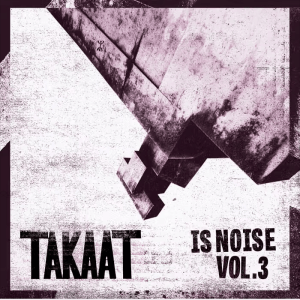
 By the third instalment of their Is Noise series, TAKAAT [pronounced tuh-cot and meaning “noise” in the Tuareg language Tamashek] have moved further from the raw collision of Tuareg guitar and punk that initially defined the project. The trio has become a duo here, without Souleymane Ibrahim’s live drums or any vocals. Vol. 3 is more exploratory and searching, less concerned with songs than with seeing how far Ahmoudou Madassane and Mikey Coltun can stretch their shared musical language. Drum machines, drones and field recordings move into the space left behind.
The four-part Ijit N’elwan begins almost by withholding TAKAAT altogether. “Ijit N’elwan 1” opens with field recordings and remains a brief, ambient introduction, establishing a sense of place before amplification takes over. The second part strips things down to an extended, heavily distorted guitar passage whose sustained tones eventually push the track into drone territory. “Ijit N’elwan 3” initially reveals something bluesier in Madassane’s playing, but gradually acquires greater weight and distortion as it progresses, while the final part heads somewhere more psychedelic.
Coltun’s comments in the accompanying interview help explain why this expansion feels natural. He draws a connection between the trance-like repetition at the heart of Tuareg guitar music and drone, as well as between the distortion of contemporary Takamba—music blasted through overloaded radios and megaphone speakers—and the punk, noise and experimental music that shaped his own listening. On Vol. 3, those affinities no longer need to be announced: they have become part of the music’s vocabulary.
There is also a deliberate sense of risk. Each new TAKAAT EP enters a different world while remaining recognisably part of the same universe, and Vol. 3 takes that idea further than its predecessors. The duo format makes the music feel simultaneously more exposed and more open-ended as well as restless and unafraid of charting new territory.
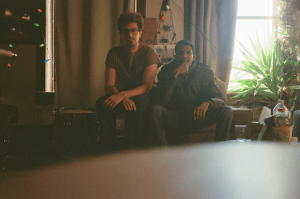 To make sense of the noise we reached out directly to TAKAAT with Mikey Coltun answering our questions.
Across the three Is Noise volumes, TAKAAT has moved quite quickly from the raw Tuareg guitar and punk energy of Vol. 1, through the live-to-tape Tinariwen reworkings of Vol. 2, to the drones, drum machines, field recordings and much denser noise of Vol. 3. Was this evolution something you imagined when TAKAAT began, or has each volume simply opened up possibilities for the next one?
Mikey Coltun: It’s been a mix of both. We knew there was a lot to explore sonically when Ahmoudou and I started the band but to what extent was a bit more unknown until we started touring and experimenting both live and during the recording process. Each Is Noise is recorded to tape. That’s kinda the overall concept. Similarly if you look at the album art (shout out to our designer Can Misirlioglu) throughout the volumes the structure remains the same but is a different perspective and zoomed out throughout each volume. This was intentional from the beginning as it relates to the music and the progression of each Is Noise volume.
Mikey, you’ve drawn a connection between the distortion of modern Takamba—particularly the tehardent amplified through blown-out radios—and the noise and experimental music you grew up with in Washington, D.C. [Andy Downing, Matter News, 4 March 2026]. On Vol. 3, do those traditions actually meet in the way you make sound, or are they still distinct references that you bring into TAKAAT from different directions?
Mikey Coltun: There’s definitely all of those influences – Takamba, punk, noise and experimental music present on Vol. 3. Similar to later era John Coltrane, a lot of Tuareg music is drone music at its core. With Tuareg guitar music, a simple chord structure with trance-like rhythms and melodies often played for long periods of time is no different than the spirituality of drone music and this is something Ahmoudou and I were interested in exploring. Taking our guitar and bass and blasting it through amps creating different sonic distortions can be also heard when seeing Takamba music live but instead of the guitar amps you have a blown out radio receiver roaring through megaphone speakers. As Ahmoudou has put it, TAKAAT is the “feeling of being in the desert at night.”
Vol. 3 also changes the basic instrumental architecture of TAKAAT: drum machines, drone synths and manipulated field recordings become central alongside Ahmoudou’s guitar and Mikey’s bass. What interested you about moving away from the more recognisable guitar/bass/drums setup of the earlier volumes, and how did that change the way you approached improvisation?
Mikey Coltun: It’s important for Ahmoudou and I to be experimenting musically and taking risks. We talk a lot about how Taureg legends Tinariwen pushed, what Tuareg music is, and what we’re doing with TAKAAT is breaking the expectations of the known Tuareg rock sound. We want each record to push into a different world while still staying in the universe of TAKAAT. This goes the same with our shows. Each tour Ahmoudou and I want to present something different with TAKAAT. The first few tours we did the trio, last tour was a duo presenting a loud drone and blown out drum machines, and next tour will be something different too. We’re taking risks and we want people to come take these risks with us. This is the only way to push out of comfort zones and create something new.
You’ve described the trust developed through eight years of playing together as something that allows TAKAAT to take risks, while Mikey has also spoken about the project as a return to a more DIY world where there is less pressure to perform in a particular way [Andy Downing, Matter News, 4 March 2026]. Does TAKAAT give you a kind of freedom that you don’t necessarily have in Mdou Moctar—and has that freedom changed the way you listen and respond to one another when you play?
Mikey Coltun: It was really clear early on touring together with Mdou Moctar that Ahmoudou and I were excited by similar music. I brought a lot of different types of bands on tour with Mdou. All of the music is by groups and artists that I love. While some of the groups could have been challenging to listeners it was important to me to draw that connection with what we were doing with Mdou. Mdou’s music was different and challenging to some in the Tuareg wedding scene in Agadez, Niger. With a lot of these bands I brought on tour I found Ahmoudou’s interest peaked. Whenever there was an opportunity on tour I would take him to see sound installations, free jazz groups, modern art, etc… and he really does appreciate that. Because Ahmoudou and I have similar interests sonically, there is a lot of trust and comfortability to experiment and try new things together with TAKAAT.
(Gianmarco Del Re)


Pingback: Recent Reviews at A Closer Listen – Avant Music News
Pingback: A Closer Listen: Recent Experimental Reviews – Avant Music News