
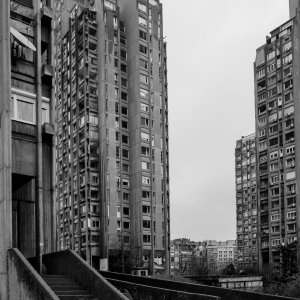
 Thematically, Post Dub Cities hearkens back to Future Sound of London’s Dead Cities, while tonally it recalls Murcof’s Rememberanza. Adriano Zanni‘s vision of a future world is the cold reflection of a present reality in which many places are already deserted: peeling houses, dilapidated storefronts, bombed villages. At one time, they teemed with life. Once humans have no more use for a city, they abandon it, leaving only rubble and questionable specters. The reasons may be as far afield as the loss of jobs, the evaporation of resources, or a campaign of bombs.
More than anything, Post Dub Cities is an album of mood. Zanni wants his listeners to be uncomfortable, to regard these cities as one does the stone wreckage of Ozymandius. From the opening notes of “Crisopoli” (also the first single), he casts a spell of resignation and despair. The pace is slow, but not sluggish; the beats restrained, but not soft. Someone has to bear witness. In “Pyramiden,” the tone grows harsher, with amplified whispers, clacking pipes and cavernous echoes.
Were it not for the dub timbres, one might call this industrial or post-industrial music. Each piece seems to hide another piece behind it: a subdued rhythm, a moving shadow. In “Centralia,” sharp beats stumble like scavengers sifting through wreckage. These visitors may not be human, or even humanoid; in Alan Weisman’s classic The World Without Us, everything from roaches to raccoons reclaims its own. Rust abrades metal; girders bend; branches break through glass.
The accompanying pdf is essential to the release. Referencing Calvino and Marcelli, Zanni writes of the empty city as an “echo chamber,” an image reflected in the music. A hundred pages of sublime black and white photographs follow, captured in cities around the world over the past two decades. The unifying feature is the lack of any human presence, as if scrubbed from existence (insert sci-fi theory here). Proof of humanity’s presence remains, but without context. In Zanni’s own words: “memory without recollection, structure without use, body without inhabitants.”
In response, the music is architectural: one imagines a grid in which beats and notes are purposely placed. Belgrade, Vienna, Amsterdam, Barcelona, Berlin, Dublin, Sarajevo, Rome, London, Prague, Madrid, Krakow, Istanbul, Lisbon, Palermo and more, all deserted: buildings empty, rollercoasters stilled, markets abandoned, art left to dissolve. Not a single vehicle is visible, even on the highway. One can see what humans have done, but not where they have gone. In what seems to be the final image, a massive wall of chairs is ready for a group of patrons who never arrive. Capturing these images must have required remarkable patience and timing.
The last bonus track, “San Zhi Pod City,” offers a surprise: the appearance of a human voice. Even this turns out to be a loop, a remnant, an echo. But Zanni does have a final trick up his sleeve: on page 99, the people reappear, filling the square. The last four images show humanity wall to literal wall: perhaps too much humanity, suggesting a reason for its removal or demise. As much as one pores through “Kadykchan” and “San Zhi Pod City” for a matching restoration, one cannot hear it in the grooves. The listener is left to ponder whether the detritus of humanity might hold any intrinsic value, or if it is only sound and fury, signifying nothing. (Richard Allen)


Pingback: A Closer Listen: Recent Experimental Reviews – Avant Music News