
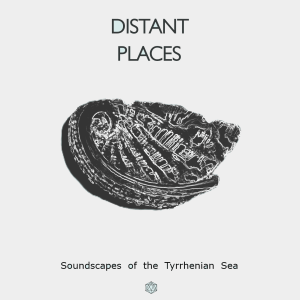
 Felice Sciorilli first graced our pages last spring, appearing on Biodiversità Records’ 14 Soundcapes with the track “Breaths.” At the time, we recognized the unique nature of the piece, capturing the sound of “air pushed through the Etruscan sandstone cliffs by the incoming waves.” “Breaths” appears on Distant Places as well, a worthy inclusion.
In a way, the album title is a misnomer. These places are not necessarily geographically distant; most come from the intertidal zone of the Tyrrhenian Sea. But as Sciorilli has a particular fascination with tide pools – some only centimeters deep – these sounds may be regarded as distant as most people seldom if ever encounter their nuances.
When one hears that an album is recorded at the coast, one expects to hear a bevy of predictable material: wind and waves, gulls and other fair-weather fowls. These make appearances, but are not primary. Instead, Sciorilli concentrates on micro-sounds made macro. In “E,” water rushes into crevasses before spurting back out, powered by the force of the waves, although this is not technically the sound of the waves. Instead, this is the sound of waves in rocks, familiar to jetty walkers. As the angles of approach vary, so do the timbres.
The tide pools first come into focus in the opening segment of “Cluster,” with a sound akin to the crackle of brine shrimp. The piece develops in movements, like the “Bohemian Rhapsody” of field recording. Soon there are crashing waves, then fizzes and pops, and finally the sound of pebbles tossing, turning, rolling back to the sea. “Bolle” and “Bubbles drift upward into the water” occupy different areas of the album while also being separated by tone. While hearing them, one recalls pablo diserens’ “The Shrinking Glacier” from last year’s ebbing ice lines, providing one with the opportunity to compare “healthy” bubbles with “unhealthy” bubbles, or bubbles that belong to a cycle with those escaping for the last time. The second piece is more effervescent, like alien birds swimming in soda; without hydrophones, one might never encounter such distant sounds.
While listening, one is amazed by the number of musical parallels that can be found in nature: the quickening tempos of “From the Tidal Edge,” the glissandos of “Outflow.” Distant Places serves as a reminder that music imitates nature, not (save for starlings) the other way around. The set builds to the eighteen-minute centerpiece “Tiny Worlds,” a longer, reworked version of a piece that made the shortlist of The Radiophonic Broadcast’s Sounds of the Year 2025-26. Recorded in a tidal pool six centimeters deep (shown in the pdf that accompanies the download), the piece demonstrates just how rich, dense and diverse a micro-world can be, although to be fair, to the local Littorina snails there also exist micro-worlds within micro-worlds, from bacteria down to the smallest atom, each with a corresponding biophony. The “characters” that appear may be animate or inanimate, but each possesses a personality of its own: squeaking and whistling, popping and percolating.
In the final piece, Sciorilli draws back from the water and embeds his microphone in the sand, muffling the sound of the nearby waves. “Under the Sand” operates as a parable. Sonic treasures are available everywhere, yet most of us never hear them; it is as if we too are buried in the sand, listening through wax and debris, treating micro-worlds as distant places although they are right beneath our feet. (Richard Allen)

