
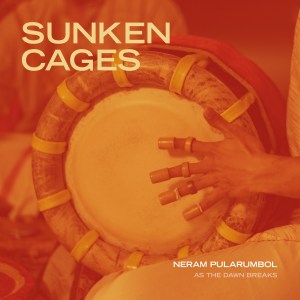
 Neram Pularumbol (“As The Dawn Breaks”) finds Sunken Cages pulling the rhythmic traditions of South India into an electronic vocabulary of bass, drones, and fractured club music. The album opens in celebratory, ebullient mode with “Kerala”, before “Elephant Dance” raises the tempo and “Idakka” takes a more synthetic path, processing patterns from the traditional hourglass-shaped Kerala drum. Breath soon becomes almost as important as rhythm. On “Darantee”, featuring Kuza, vocal exhalations and percussion give the music a physicality that draws on the agricultural and folk roots of South India.
The connection with Kerala runs throughout the record, particularly through the collective force of its percussion traditions. “Drum and Flowers” imagines Chenda drums within a celebratory night dance, their increasingly animated rhythms rubbing against darker industrial sounds. “Athiraavile” — Malayalam for “early in the morning” or “at the break of dawn” — shifts the scene towards daybreak, combining an unprocessed Chenda melam pattern with heavy electronic beats and Rani Jambak’s incantatory voice. Throughout, traditional instruments remain clearly audible even as their rhythmic properties are stretched, fragmented and repositioned.
The second half effectively takes that process apart again through a substantial series of remixes. “Drum and Flowers” alone appears in three new iterations: Weldroid, Lila Tirando a Violeta and El Kontessa pull its rhythmic framework in sharply different directions, at points veering towards acid, jungle and deconstructed club music. The source material consequently keeps changing hands and contexts, with each version exposing possibilities latent in the original.
For all its electronic density, Neram Pularumbol eventually circles back towards the physical act of playing. “Kerala (Moki McFly Remix)” brings proceedings to an apt conclusion, returning percussion to a more tactile foreground and introducing distinctly jazzy, free-form leanings. The album begins and ends with “Kerala”, but the intervening transformations ensure that the return doesn’t feel quite like arriving at the same place.
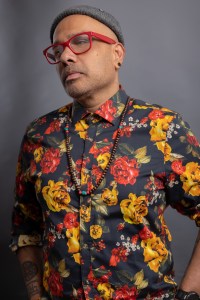
photo by Mike Vanemon
To find out more about the production process for the album, we got in touch directly with Ravish Momin (aka Sunken Cages).
The liner notes to Neram Pularumbol use resynthesis not simply as an electronic process but as a metaphor for taking culture apart into its constituent elements and putting it together differently, in opposition to the idea of tradition as something “frozen, solidified and sanctified”. That does seem particularly audible on Neram Pularumbol, where South Indian instruments and rhythmic languages are present but rarely allowed to function as straightforward markers of heritage.
What exactly are you trying to preserve when you dismantle and reconstruct a tradition in this way, and at what point does transformation become more important than recognisability? Does this also connect with what you have described elsewhere as “resynthesizing the traditional” and decolonising conventional ideas of so-called global music?
Thanks for this great question! The best analogy to start with is to think of making a photocopy of a photocopy. Even 8-10 generations of copies later, they do not resemble the original, get distorted and warped, and perhaps even a new narrative emerges. This process itself is of deep interest to me and what I’m hoping to preserve.
When I think of a rhythm I’ve learned in the past, it’s more about how I’m recalling it in the moment, with all the unconscious inspirations and changes that get added over time- to be left with a transformation that’s an impression, an organic reimagining- similar to what happens to our own memories over time.
Furthermore, I’m taking these ‘resynthesized patterns’ and placing them in a new framework of synths, drones, and other electronic elements that I’ve absorbed, to create a new global-music that simply doesn’t rely on invoking the past. I need to be careful to add that all this does not mean a blatant disrespect of the culture and tradition, but to be left with recognizable elements-like the sounds and basic structure of a pattern- in an arrangement that may be unfamiliar. That’s where the decolonizing takes shape.
Music is predicated on a dynamic process of growth and evolution, yet too often non-western artists are expected to be performative of their culture, and their use of contemporary technologies or drawing inspirations from western genres is considered disingenuous. Gatekeeping and branding from western ethnomusicologists and curators has a long problematic history, but I’ll leave that discussion for another time 🙂
Neram Pularumbol is particularly rooted in the musical traditions of Kerala, from the title itself to “Idakka”, named after the hourglass-shaped drum associated with Kerala’s temple music. Yet you don’t present these traditions ethnographically or attempt to reproduce them faithfully: their rhythmic and timbral characteristics are broken apart and absorbed into electronics, bass and club structures.
Which particular Kerala musical traditions, instruments or rhythmic practices fed into this album, and what is your own relationship to them? Are there elements that you consciously wanted to retain in recognisable form, and others that you felt could only remain alive by being transformed?
Hopefully my previous response lends some insight to this question as well. To elaborate, I’ve always found group drumming to be powerful, an action of resistance and solidarity as well as of spiritual significance. Particularly, I was mesmerized by music performances known as Chenda melam in which hundreds of artists sync and perform together during temple festivals in Kerala. The drums native to Kerala, like the Chenda, Idakka and Elathalam, also have markedly different timbres/sonorities from the North-Indian drums such as Tabla and Dhol to which one may be accustomed to hearing.
While I’m originally from South India (Hyderabad) myself, I currently split my time between Brooklyn and Philadelphia. I did not grow up in Kerala, India, but I wanted to think about what a meaningful recreation of those rituals into my own worldview, that was culturally respectful as well, would represent.
For example, On “Drum and Flowers,” I created a narrative with shifting tempos where the Chenda drum is used in a celebratory night dance, after the workers have come home. A multitude of drums lead the celebrations, shedding industrial grime for synchronized movements that quicken, a shared bodily memory of ancestral resistance and resilience. The song is punctuated with industrial textures and dark synth stabs that represent the rigor of factory-work.
“Idakka,” the track to which you’d alluded earlier, runs the Idakka drum patterns through various delays and echo filters to create this cavernous rhythmic feel where machine-like sounds are also ever-present. Here the traditional elements are drastically transformed and chopped up, signifying a not-too-distant future where machines threaten to take over humanity.
On “Athiraavile,” which features the Indonesian producer/vocalist Rani Jambak, I actually used a clean / unprocessed Chenda melam pattern on top of heavy electronic beats. Here, Rani lends a shaman-like call to prayer- not belonging to any specific religious denomination- where people gather to play drums at dawn.
The second half of the album effectively allows other artists to take your rhythmic material apart again. “Drum and Flowers” is especially revealing because Weldroid, Lila Tirando a Violeta and El Kontessa pull the same source towards very different rhythmic and electronic environments, while Masma Dream World and Moki McFly produce two strikingly different versions of “Kerala” and Kush Arora makes “Idakka” considerably harsher and more propulsive. You have said that these collaborators were chosen partly through relationships you have built with artists around the world who approach tradition as something mutable rather than fixed.
When you heard the finished remixes, did any of them reveal something in your own compositions that you hadn’t realised was there? And does handing the music over to artists from such different cultural and musical contexts become another stage of the album’s idea of resynthesis?
The remixes were as much a part of the album as the tracks. And a resounding yes to your observation of having these remixes represent a further reshaping of the source-material, as multiple layers of resynthesis now exist 🙂 Each artist brought their respective cultural background, musical aesthetic and production style to the table.
Back during the pandemic lockdown in 2020, I’d actively sought out remote collaborations with artists in different corners of the globe. I do want to emphasize that it was also important for me to support women artists, do my part to highlight them in a male-dominated electronic music scene. Over the years, I’ve maintained my goal of building a musical community with diverse collaborators who all take musical risks and blend the traditional to the digital in their own practice.
As an artist with a remix track-record of my own (Babani Sound System, Batida’s Ikoqwe, Depeche Mode, dragonchild and Thollem), I’ve spent a lot of time listening to a given track to quickly hone in on elements that resonated with my aesthetic- whether it was a vocal phrase, a melody or a rhythmic motif. The objective was to take apart the original track and re-stitch it back together highlighting that chosen element, in ways that wouldn’t be predictable.
El Kontessa added a doumbek pattern to the underlying rhythm and made it feel like it was always there, as if South Indian and Egyptian musicians jammed all the time. Masma Dream World took the drone elements of “Kerala” which I’d intentionally layered heavily, to create a very cinematic track with a stripped down minimal beat. Weldroid’s acid synths and bit-crushed elements gave the track a dance music of the future energy. Lila Tirando a Violeta removed my rhythmic elements entirely and energized the track with a Jungle vibe. Moki Mc Fly seemed to instinctively grasp my AACM past- which was grounded in their ancient to the future motto- and brought an acoustic Free-Jazz tribute to the Art Ensemble of Chicago to his remix.
Neram Pularumbol means “As The Dawn Breaks”, while the name Sunken Cages itself has a much darker environmental origin: you have described the “sunken cage” as an image of something once held captive becoming submerged by rising waters, reflecting your background in environmental engineering and longstanding concern with climate change. Yet this record often feels less apocalyptic than that image suggests: despite the drones, industrial textures and moments of considerable darkness, there is movement, colour and a sense of emergence.
What does “dawn” mean within this record? Is it intended as a counterweight to the darker implications of Sunken Cages, or do you see destruction, transformation and renewal as parts of the same process?
For the past few years, I’ve been thinking a lot about the duality of the nature of water, as a source of survival and also as one of destruction. While there is a sense of hopelessness that comes from realizing that some of the impacts of climate-change are irreversible, there is also hope in focussing on environmentally sustainable practices.
Rather than thinking of dawn as a counterweight to the bleakness of the overarching climate narrative, I wanted to leave its symbolism ambiguous. In other words, we can meet the dawn feeling powerless or prepare to transform our future for preservation. On a broader level, the choice still doesn’t seem to have been made.
As far as the tracks go, I play with the tension between the forces of darkness and rejuvenation- with the industrial sounds/textures on the verge of overpowering the ancient rhythms and chants, which signify our humanity, and certainly different tracks allude to different outcomes of that struggle.
PS. Since this interview took place, Momin has released Morning Birds and Distant Drums, a new album with Haitian “soundchemist” Val Jeanty as Turning Jewels Into Water. Taking the AACM credo “Ancient to the Future” as a guiding principle, the record brings their Indian and Haitian lineages into a kinetic dialogue with improvisation and contemporary electronics.
(Gianmarco Del Re)

