
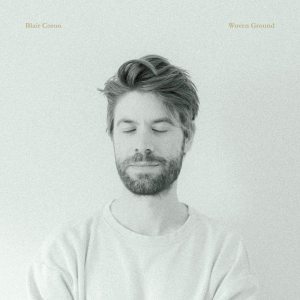
 Is Woven Ground an EP with an accompanying film, or a film with an accompanying EP? We’ll leave it to the project’s viewers and listeners and to decide. Either way, Blair Coron‘s multi-media release is a treat for the eyes and ears, a celebration of Scottish forests, islands and glens, filled with lush instrumentation, poetry and harmony, coupled with sumptuous landscapes and insightful interviews.
As Coron explains, “I could never say, ‘This song is the river’ or ‘these words are the forest’ … so I took my instruments and recording equipment and friends to the places I was writing about.” The landscapes are first seen from a moving car, then the disembarking, revealing the sounds of the village and the port.
In the early minutes, Coron celebrates the gift of the Isle of Canna, a sacred trust and sanctuary. The cows seem as relaxed as the strings and historical piano, or the other way around. The views are bucolic, the pace of life unhurried, the area seemingly free from pollution, time in suspension. The natural soundscape is allowed to take center stage (more detectable in the film than the EP). In the first interview, one learns of apple trees fertilized by the bodies of seals. Farmland equipment lies abandoned; an ancient church stands witness. Local residents express pride in their location and history. Shoes off, windows open, Coron engages with the piano; “Isle of Canna, Midsummer, 5:54am, 2026” arrives a third of the way into the film, but is the EP’s opening piece, a love letter to the location.
The next piece takes a little more work; a harmonium is not an easy instrument to move, especially across uneven terrain. The sprightly “Sgùrr A’ Mhaoraich” is performed by a babbling brook, with Charlie Stewart on the much more portable fiddle. The piece is an ode to the countryside and the flowing water, whose music never ends. As the camera zooms in to the reel-to-reel, the recording device begins to look like a stream.
Coron sits outdoors at a table, reciting “Beneath Six Black Poplar Trees,” a poem that looks back to the dawn of creation, with creation itself the accompaniment. His voice is comforting, with gentle inflection that matches the spider webs undulating in the wind. The strings return, setting up the gorgeous closer, which includes Miwa Nagato-Apthorp and Zoe Bestel on layered vocals. “Hymn,” while not on the EP, is one of the highlights of the film (35:12-38:06, a music video on its own). An adjacent version was released on the Two Old Songs EP in April, the original on On the Nature of Things, but we like this choral version the best. For “Moon Lament,” the quartet sits in the woods, captivated and captivating, having become part of the visual and sonic scenery, melting into the forest like the voices of the water and the wind. This ebullient song is chased by warm laughter and the twittering of birds; the camera draws back, revealing canopies of green.
Woven Ground the EP becomes a souvenir of Woven Ground the film. The images resurface when playing the music, stored in the memory as the seeds are stored in the earth. (Richard Allen)

