
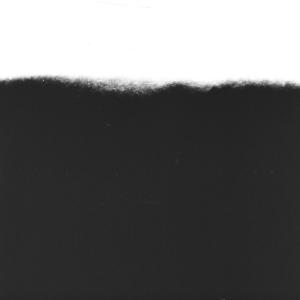
 “There are black silences, like thunderclouds, that burst into flashes of music,” H. G. Wells writes in Select Conversations with an Uncle. The phrase finds an almost literal visual counterpart in Jordan Reyes’s cover for Songs for Sad Poets Vol. III: a dense black expanse pressing against a bleached, nearly featureless sky, its uneven boundary resembling storm clouds seen in negative. It also anticipates a pivotal moment in “Sigils of Decay”, when the music comes to such an abrupt halt that, on first hearing, I had to check whether it was still playing. Out of that prolonged absence a low rumble eventually emerges, giving voice to the disquiet that runs through the latest collaboration between Siavash Amini & Eugene Thacker.
The three pieces included are dedicated respectively to Vietnamese poet Hàn Mặc Tử, Brazilian Symbolist João da Cruz e Sousa and Austrian poet Nikolaus Lenau, figures connected by the tradition of the poète maudit. “Leprous Doubt”, for Hàn Mặc Tử, opens with dissonant textures, degraded sounds and sudden changes of register. It is unsettling and unsettled, meandering in unforeseen directions and making its discomfort palpable. The music pauses and resumes, pitching antagonistic forces against one another; moments of sweeping grandeur coexist with passages of intimate travail. It repeatedly attempts to steady itself before faltering again. Circular tones eventually lift to reveal the “glowing abyss” of Thacker’s poem, while intensifying drones recede until a solitary, quivering tone remains.
“Sigils of Decay”, for Cruz e Sousa, pushes this instability into silence itself. The long interruption at its centre makes the eventual return of sound unusually physical. As the low frequencies slowly reassert themselves, muted fragments accumulate into a dark, suspended mass. Thacker writes of “muted music / woven by / night spiders”, an image that seems uncannily close to what Amini constructs: strands of sound gradually spun into a crepuscular firmament of drones and disarticulated fragments, only to loosen again. The connection with Cruz e Sousa is equally suggestive. His poetry transforms an inexplicable melancholy into a confrontation with the Infinite; Thacker condenses that metaphysical sadness into the colder “Dread of / Infinite space. / Dread of / Distant skies.”
At nineteen minutes, “Dead Eyes, Dark Stars” is the album’s most expansive piece. Its opening is nocturnal, with celestial voices suspended above slumbering coils of sound. These gradually precipitate into increasingly abrasive textures, yet the music pulls itself back towards a softer harmonic balance. Timbral shifts become more pronounced as the underlying material turns metallic and resonant. Lenau’s recurring world of night, forests, barren landscapes, grief and death finds an oblique counterpart here: the landscape seems to have been emptied of narrative and retained as atmosphere, shadow and distant light.
Voice assumes a much greater presence than on the first Songs for Sad Poets, although words never present themselves as intelligible text. Synthetic voices gather into spectral choirs and dissolve into the surrounding music, allowing Thacker’s poems to remain embedded within the pieces without requiring the listener to follow them line by line. The relationship between poetry and sound consequently operates through images, structures and emotional pressure: Hàn Mặc Tử’s diseased bodies and impossible skies, Cruz e Sousa’s metaphysical melancholy, Lenau’s nocturnal desolation.
Each piece finally leaves a coda of silence. By then, Reyes’s cover feels increasingly inseparable from the music: darkness occupies most of the field, while its opposite persists beyond its ragged edge. H.G. Wells’s “black silences” provide an apt description of an album where silence continually threatens to swallow the music, yet also provides the space from which it can begin again.
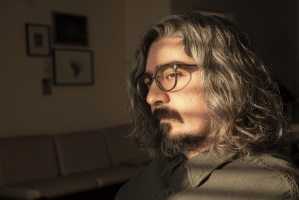 To lift the veil on the production process we have spoken directly to Saivash Amini.
On the first Songs for Sad Poets, Eugene Thacker’s poems were never actually spoken; the words were translated into sound without becoming voice. On Vol. III, you take almost the opposite route, programming voice-synthesis software to perform the poems and then processing as many as forty voices until language becomes unintelligible.
What interested you in bringing the human voice into the project only to erase its legibility again? Do you still think of these pieces as songs, or has the distinction between voice, text and sound become irrelevant?
The idea of voice synthesis came out of a conversation with Eugene about his dislike of the human voice and the vocal music he actually liked like Ligeti’s requiem, where micropolyphony, among other techniques, were used to mask the intelligibility of the text and transform the human choir into something entirely different.
I have much of the liberty of a large choir in my DAW with voice synthesis software. It’s not actually a human voice, so I can make a sound very modulated and affected when singing. And I can have as many as I want to have, as long as my CPU can handle it, so micropolyphony can be much more extreme and differently intricate.
And yes, I do think of these as songs, they are structured around the poem. Just not conventional songs with known musical structures. But that’s when I’m making them. There’s no point trying to find the points of reference to poems if you’re just listening, they are trying to convey the same thing.
Listening closely to the three pieces, decay seems to function as a compositional process rather than simply as an atmosphere. “Leprous Doubt” repeatedly loses substance and regains it; “Sigils of Decay” moves through accumulation and withdrawal; and the nineteen-minute “Dead Eyes, Dark Stars” forms large masses of sound that gradually weather away, return and finally disappear. This concern with appearance, erosion and reconstitution also seems connected to Eidolon, Caligo and Severed Like the Red Moon, where sounds are made to float, bleed, collapse, be mutilated and reassembled. Has this become a central way for you to think about musical form?
Yes and no, I have been more and more putting focus in making structures and out evolving and directional textures made out of different approaches to generating harmony. It’s not all I think about when making pieces but more likely the result of intentional putting together of smaller directional elements of different duration. So the micro is what determines the macro, and a lot of the times I’m thinking of micro.
The poets invoked on Vol. III come from very different linguistic and cultural histories: Hàn Mặc Tử and Vietnam’s “Chaos” school, João da Cruz e Sousa and Brazilian Symbolism, and Nikolaus Lenau and the tradition of Weltschmerz. How did you and Eugene Thacker arrive at these particular figures, and what drew you to bringing such different poetic traditions together within the same musical cycle?
That’s all Eugene’s side of the project but the thread that links them all is in the Poet Maudit term which the title comes from. They all fit that category.
Much of your recent work has begun from literary or historical material: Ibn Sina on eremos, Xavier Villaurrutia on The Sweat of Earth, early Iranian piano recordings and Malakoot on Caligo, as well as Houshang Golshiri on Severed Like the Red Moon. In each case, the source seems to act less as something to illustrate than as a force that changes the way you treat sound. What does literature give you that a purely musical starting point does not, and has worked so closely with Eugene Thacker altered the way you now read a text as a composer?
Using literature for my work goes to my first album. Then I have three collaborations with Matt Finney which were based on his reading his poems and sending them to me. Serus had a strong relationship with the writings of Blanchot I can go on…
I find using literature gives me a structure and image which I can turn into sound worlds. I can imagine something to convey that image. I find that very exciting but a lot of background work before the project starts is done on purely musical material.
Working with Eugene changed my workflow in general and made my relationship with literature deeper than it was before, and it gave me a lot to think about when it comes to making sound that conveys what one word is telling me.
(Gianmarco Del Re)

