
 Gholam-Hossein Sa’edi’s The Mourners of Bayal (1964) remains one of the defining works of modern Iranian literature. Across eight interconnected stories set in the fictional village of Bayal, Sa’edi explores poverty, famine, superstition, grief and death through a world where collective anxiety gradually erodes the distinction between reality and hallucination. Equally striking is his attention to sound. The village first announces itself acoustically: dogs bark across rooftops, a bell drifts through the darkness, voices pass from window to window, footsteps punctuate long stretches of silence. Bayal is heard before it is fully seen. Tegh & Adel Poursamadi respond directly to this sonic imagination, drawing not on the individual plots of the stories but on their atmosphere and, above all, on the way Sa’edi constructs the village through listening as much as through sight.
Like Ima and After You Left, Bayal بیل grew out of extended improvisational dialogues between Tegh’s electronics and Adel Poursamadi’s violin, viola and traditional Iranian instruments before being carefully sculpted into finished compositions. Yet this third collaboration feels markedly more concentrated than its predecessors. The earlier records moved through broader dynamic contrasts, opening onto expansive drones. Bayal بیل occupies a narrower emotional register, maintaining an almost continuous state of subdued tension lending the album a quiet claustrophobia entirely in keeping with Sa’edi’s village, where lives unfold beneath the weight of forces that remain largely unseen.
The opening “Black Stone” establishes that landscape from the outset. Electronics and bowed strings emerge from a dense greyscale haze where instrumental identities remain deliberately obscured. Sounds appear like distant outlines. “The Cow” deepens this sense of collective but undefined presence. Throughout the piece, faint layers of indistinct voices drift through the mix like fragments of overheard conversation, suggesting the murmur of Bayal’s unseen inhabitants as they move through alleys and courtyards beyond the listener’s field of perception. These ghostly traces repeatedly dissolve into silence before returning once more, punctuated by resonant strikes that resemble a ritual gong, briefly gathering the surrounding sounds before allowing them to disperse again. The effect closely recalls Sa’edi’s opening pages, where barking dogs, distant bells and whispered exchanges establish the village long before individual characters emerge.
“Toward the Vast Mountain” broadens the perspective without abandoning the prevailing sense of enclosure. Percussive markers recur throughout the piece, functioning almost like ritual or processional signals that quietly propel the music forward through its suspended atmosphere. The composition advances with measured inevitability, each percussive gesture subtly reorienting the listener while strings dissolve into electronic residue. “Pāpākh” is the shortest track on the album and refers to the village dog in Sa’edi’s stories, whose barking, pacing and sudden silences are interpreted by Bayal’s deeply superstitious inhabitants as signs of looming disaster. The music mirrors that heightened state of alertness without becoming illustrative.
“Zanguleh” occupies a distinctive place within the album. Whereas much of Bayal treats the strings as part of a larger electroacoustic fabric, here Adel Poursamadi’s playing comes decisively to the foreground. Long, lyrical violin lines unfold over a restrained electronic backdrop whose role is less to obscure than to sustain the instrument’s resonance. The piece carries the emotional weight of a lament, offering the album’s clearest expression of grief without disturbing its overall restraint. After the denser first half, its relative transparency feels almost startling. The closing “Under the Willow Tree” follows naturally, letting suspended harmonics, slowly decaying resonance and carefully measured silences carry the emotional weight long after the final sounds have disappeared.
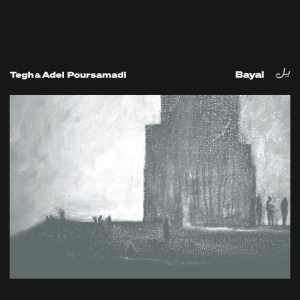
The artwork by Atoosa Pourhosseini extends this vision with remarkable coherence. Anonymous figures occupy the margins of a blurred architectural landscape whose contours dissolve beneath mist, grain and diffuse light. The image perfectly reflects Tegh’s description in the liner notes of approaching Sa’edi’s village from the crest of a hill, where movements remain visible but faces, conversations and individual lives disappear into distance. Like the music itself, it withholds detail in favour of atmosphere, inviting the viewer to contemplate Bayal from the same remove that shapes the album’s entire aesthetic.
The affinity between Sa’edi’s prose and Tegh and Poursamadi’s music extends beyond mood. The Mourners of Bayal rarely explains events directly, allowing rumour, fragments of dialogue and sensory details to shape the reader’s understanding. Bayal follows the same logic. Voices remain indistinct, instrumental identities blur, and meaning accumulates through resonance, silence and suggestion rather than narrative illustration. Slow, and foreboding, the album faithfully captures the psychological climate of Sa’edi’s fictional village, translating one of the great works of Iranian literature into an electroacoustic language of emotional depth.
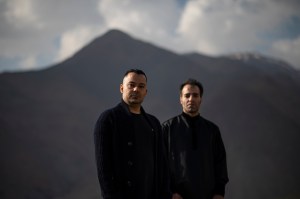
photo by Aram Tahmasebi
To find out more we reached out directly to Tegh and Poursamadi. Unfortuantely, due to the current situation in Iran, only Tegh was available to answer.
Ima ایما imagined post-human communication through a dialogue between acoustic instruments, Iranian traditional music and electronics, while After You Left revolved around memory and uncertainty. With Bayal, the starting point is much more concrete: Gholam-Hossein Sa’edi’s The Mourners of Bayal. Yet the new album also feels more restrained and claustrophobic than the previous two, remaining within a remarkably narrow emotional and dynamic range. Did the world of Sa’edi’s book lead you towards this concentration, or was this already a direction your musical dialogue was taking after After You Left?
TEGH: Yes, exactly. The atmosphere of the book had a very strong influence on the sound of the album. IMA was supposed to be the first chapter of a larger project. The idea was to continue the project by working with other musicians from different backgrounds and bring different worldviews into the kind of world-building I had in mind. Unfortunately, this part of the project has not really worked out so far.
But after the first album, both of us wanted to continue working together. We wanted to keep the colours, contrasts and freedom that we found in the making of IMA, but develop them further and make them more mature. We felt that this could give us a lot of potential for different kinds of experiments, both in terms of meaning and technique. This led to After You Left, and I think it will also be present in some of the work we release in the future. But Bayal follows a different path. I see it as a completely different chapter. As you said, the album stays within the space it presents initially, and to me, the pieces have very simple forms of storytelling, and these qualities came from our personal reading of the atmosphere of the book.
In The Mourners of Bayal, it was not so much the events themselves that affected us, but the atmosphere of the book. I feel that this atmosphere does not change very much throughout the book and stays with you. The political and social uncertainty in the stories, the way everything is unreal and yet it becomes believable, and the fact that the stories seem to be made up of people who feel isolated from each other, maybe strangers to one another, and sometimes even strangers to themselves, all affected us. This idea of alienation is present throughout the book. Even in that small fictional village, society itself can hurt and oppress people. The village is surrounded by poverty, death, illness and hunger. All of these things pushed us towards creating a more claustrophobic and oppressive atmosphere in the album.
Maybe “post-defeat” is the right word for it. That is my own personal way of describing it.
What struck me while reading The Mourners of Bayal is how much of the village Sa’edi constructs through sound: barking dogs, bells, footsteps, voices travelling between houses, and long stretches of silence often precede any clear understanding of what is happening. Your description of approaching Bayal “from the top of a hill”, hearing cries and other sounds without being able to make out their details, seems closely related to this. Were you consciously responding to Sa’edi’s use of sound and listening as literary devices, and how did you translate that sense of hearing a community at a distance into pieces such as “The Cow” and “Pāpākh”?
TEGH: I think that is exactly spot on. Sa’edi’s use of sounds, and the way he created the atmosphere of the book through them, was one of the reasons we chose this specific work. It was not really a conscious decision to respond to this aspect of the book. We never really sat down and talked about choosing this direction. I think we were simply influenced by it to such an extent that it found its way into the album naturally.
For example, there is the sound of the bell attached to the empty carriage, coming from far away in the desert. It is mentioned several times throughout the book, often in connection with moments where there is death. The character of this sound, and the meaning it carries, had a strong effect on us and led us towards making “Zanguleh,” which means “bell” in Farsi. It might sound strange or unrelated, but this carriage and its bell also remind me of the cart in Béla Tarr’s The Turin Horse. It creates a very heavy image like that in my mind.
The idea of looking at the events from a distance, as if we were standing on top of a hill looking at the village, came from our wish not to create a direct sonic retelling of the book. This perspective allowed us to stay away from simply recreating the events and focus more on what we personally felt from the atmosphere of the book and do our own thing based on that. We wanted to make music based on the effect the book had on both of us, rather than trying to represent the story itself. That is also why we left quite a lot of time between reading the book and starting to make the music. We wanted to forget as many details of the stories as possible and work only with what had remained in our minds, and of course it helped us avoid using the sounds from the book in a more literal way.
For example, Papākh, the village dog, is one of the most important characters in the book for me. He has a strong presence, and in a way he observes everything while remaining silent and the villagers have a strange relationship with him. In general, the villagers have very close relationships with animals. The relationship between Mashdi Hassan and his cow, Islam and his goat, Papākh and the villagers, all stayed in my mind. The fact that this is a village suffering from famine, where some people have to go from one village to another to beg or steal food, but they still do not kill their animals for food, was particularly striking to me.
The two tracks came out of this. We were more interested in making music out of the feeling we got from the presence of these characters in the story, rather than directly referring to the sound of Papākh or Mashdi Hassan’s cow.
You describe the recording process as a series of improvisational dialogues that were subsequently processed and structured, with responding to the concept taking precedence over conventional musical rules. From your perspective, how does that process work? When Adel produces a sound, are you responding to it electronically in real time, or do the more radical transformations happen later during editing and processing? And at what point, for you, does an improvisation cease to be the documentation of a performance and become a composed piece?
TEGH: Naturally, this way of working was not something new for Adel and me. We worked in an almost similar way on the two previous albums as well. We talked a lot about the effect the atmosphere of the book had on us. We both knew what elements of it made us hear things, and what kind of feelings we wanted to communicate. But we never really talked about what the tracks should sound like, what their structure should be, or what we should or should not do.
The process usually started with one of us doing something, and the other responding to it. This would continue through different sessions, and then we would listen back to the recordings. Sometimes, from a one-hour recording, only one melody and one beat would come out, like in “Toward the Vast Mountain.” We felt that they were close to the concept we had in mind, and then we developed them into a track at a later stage. “Zanguleh” and “The Black Stone,” for example, both came out of the recording of a single session. A lot of the changes and processing happened afterwards, especially the processing of the sounds and shaping the forms. This was important for bringing the different sounds together and making them feel like they belonged to the same world.
One of the main reasons for this is that I am honestly not a very good improviser. In many of the sessions, instead of being able to immediately reach the sound I had in mind, I was more often just leaving some kind of indication of what I wanted to reach later. For example going back to “Toward the Vast Mountain,” I had already written a beat for the melody in the improvisation, but the sounds and the pattern were quite different from what you hear on the final track.
As for the last part of your question, it is a little difficult to explain. There is a point during the process when you suddenly think, “Ah, we found it. This is becoming something.” It is a moment when you find each other, everything starts to work together, and you feel that you have reached something. For me, that is the point where I can change the way I look at the material. I can stop thinking only about finding sounds or making the improvisation work, and start looking at what we have from the perspective of storytelling and how the idea can develop, where it can go, and how it can become a composition.
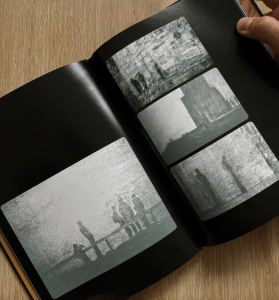
artwork by Atoosa Pour Hosseini
One of the most affecting moments for me is “Zanguleh”, because Adel’s violin suddenly becomes much more exposed and lyrical after spending much of the record partially submerged within the electroacoustic texture; it almost functions as a lament before “Under the Willow Tree” carries the record towards silence. Across Ima ایما , After You Left and now Bayal بیل, has your understanding of the relationship between strings and electronics changed? Are you increasingly interested in making it difficult to tell where one ends and the other begins, and what made you choose to break that ambiguity so strikingly on “Zanguleh”?
TEGH: Absolutely. One of the things I personally question now after several years of working with Adel is exactly this. In IMA, and to some extent in After You Left, there is still quite a clear distance between the sound of the instruments and the electronics. Maybe you could say that the meeting between my world and Adel’s world did not always become a third world, something that was neither completely mine nor completely his. I think this improved in After You Left, and we got even closer to it with Bayal.
I would not necessarily say that I am trying to make it difficult to tell the sounds apart. What is more important to me is that, in the composition, sound design and all the different stages of the process, I do not treat the instruments and electronics as separate things. I also try not to let the source of a sound decide how I treat it. I want to reach a point where by the end of the process there is a kind of continuity between the sounds, and they feel like they belong to the same family. It does not matter whether you can recognise where each sound comes from, what matters is that when these different sonic characters are put together, they do not feel like they have been taken from completely different worlds and simply placed next to each other like a collage.
As for “Zanguleh,” as I mentioned earlier, the track was influenced by the sound of the bell coming from far away in the story. In my personal interpretation, I connect this sound with death, not as an ending, but as something that has been staying with you. As you said, that section was meant to work almost like a lament. It is actually a mourning. Our idea was for the track to reach a point where it could finally break out and mourn freely, and that is where the track ended up.
(Gianmarco Del Re)

